AI search is not the future—it’s the present. With tools like ChatGPT, Google’s AI Overviews, and Perplexity reshaping how people discover brands, one question looms large:
Will your business still be visible when AI search takes over—or will you vanish into digital obscurity?
According to Semrush data, AI-driven traffic is on track to overtake traditional search by 2028. That means ignoring AI SEO today could cost you your customers tomorrow.
- But here’s the controversial part—
- Traditional SEO alone won’t save you anymore.
- Old keyword stuffing and link-building tricks? Useless.
- Even ranking #1 on Google might not matter if AI tools don’t cite you.
Why It Matters:
“Kyuki agar aapka brand AI tools (Google AI Overviews, ChatGPT, Perplexity) me visible nahi hai, toh aap customers ke saamne hi nahi aayenge — chahe aapka Google ranking kitna bhi strong ho.”
How to Rank in AI Search in 2025: 6 Tactics from Industry Experts
So what actually works in 2025? Let’s break down 6 expert-approved tactics—but I want you to question them, challenge them, and share your own thoughts in the comments.
1. Track and Benchmark Your AI Presence: Are You Even Visible?
When was the last time you checked how ChatGPT or Google AI describes your brand?
- Does it even mention you?
- Is the sentiment positive—or brutally negative?
- Are your competitors stealing the spotlight?
Alex Birkett (Omniscient Digital) argues: “Visibility is not the only goal. Accuracy and sentiment matter more.”
But what do you think—
Would you rather appear often in AI search, even with neutral sentiment, or less often but always positively framed?
Try checking your brand’s share of voice and sentiment score with AI SEO tools. And be honest—what did you find? Drop it below.
2. Build Brand Authority: Is Popularity the New SEO?
Kevin Indig’s research shows brand search volume is the strongest predictor of whether AI tools mention you.
So here’s the big question:
Is AI search becoming a popularity contest where only big brands win?
Tactics to fight back:
- Guest post on authority sites
- Publish data-driven studies (AI loves citing numbers!)
- Be active on Reddit, LinkedIn, and industry forums
But let’s debate—if smaller brands don’t have huge budgets, how can they realistically compete? Do you think AI search will widen the gap between big and small players?
3. Structure Your Content for AI Extraction: Should We Write for Humans or Machines?
AI tools don’t just “read”—they interpret. That means if your content isn’t structured clearly, AI simply won’t use it.
- Use headings, bullet points, Q&A formats
- Add schema markup
- Front-load answers
But here’s the controversial thought:
If we start writing content mostly for AI systems, are we slowly killing creativity and human-first writing?
Would you prefer a world where all blogs sound “machine-optimized” or where messy but creative voices still shine?
4. Refresh Your Content: Do You Update Enough?
Seer Interactive found 65% of AI bot hits go to content published in the last year. Translation: if your blog is old, it’s invisible.
But let’s question this—
👉 Should we spend more time creating fresh content or constantly updating old posts?
👉 Is updating old content “cheating” the system, or just smart SEO?
Personally, I think content updates are non-negotiable. What’s your strategy—publish more, or refresh more?
5. Build Content from Real Questions: Are You Listening?
Forget keywords for a second. What are your customers actually asking?
Examples:
- “Why isn’t my Shopify store ranking?”
- “Are there chargeback solutions for subscription businesses?”
Companies like Chargeblast used AI SEO tools to find real customer prompts and built content around them.
But here’s the debate:
👉 Should businesses create hundreds of hyper-specific pages for every customer question—or will that clutter their site?
👉 Where’s the balance between answering everything vs. focusing on a few high-value questions?
6. Use Video as a Citation Magnet: Is YouTube the New SEO Goldmine?
Data shows YouTube is the 3rd most-cited domain in AI answers. Think about it—how often do you see AI tools pulling video tutorials into their results?
That means if you’re not publishing videos, you’re leaving citations (and traffic) on the table.
But let’s ask the hard question—
👉 Do you believe every brand should become a video creator, or is video marketing overrated hype?
Drop your thoughts. If you’ve ever had AI cite your video, I’d love to hear that story.
Traditional SEO vs AI SEO in 2025
Before we dive into the tipping point, let’s quickly see how AI SEO is already rewriting the rules compared to traditional SEO
| Factor | Traditional SEO | AI SEO (2025) |
|---|---|---|
| Focus | Keywords & backlinks | Search intent + context + EEAT |
| Content Style | Blog-style, keyword optimized | Conversational, structured for AI extraction (Q&A, schema, bullet points) |
| Ranking Signal | SERP position (#1 rank) | AI citation & mention (visibility in ChatGPT, Google AI Overviews, Perplexity) |
| Content Update Needed | Evergreen content works for years | Freshness critical (updated within last 12 months) |
| User Experience | Optimized for Google crawler | Optimized for both humans + AI systems |
| Measurement | CTR, impressions, ranking | AI visibility score, sentiment, share of voice |
| Competition | Anyone with good SEO can rank | Strong brands with authority get preference (brand signals matter more) |
| Tools | Google Analytics, Search Console | AI SEO audit tools, sentiment analysis, prompt-based keyword discovery |
| Outcome | Website traffic growth | Direct brand mentions & qualified leads from AI search answers |
AI Search vs Traditional Search: The Tipping Point (2025–2028)
“SEO ki duniya ab ek historic shift ke edge par hai. Semrush ke recent AI SEO study ke according, AI search visitors 2028 tak traditional search visitors ko cross kar denge.”
Matlab simple hai:
- Jo businesses sirf traditional SEO par rely karte hain, unki visibility time ke saath girti rahegi.
- AI search me jo brands consistently cite hote hain, wo apna market share double kar lenge.
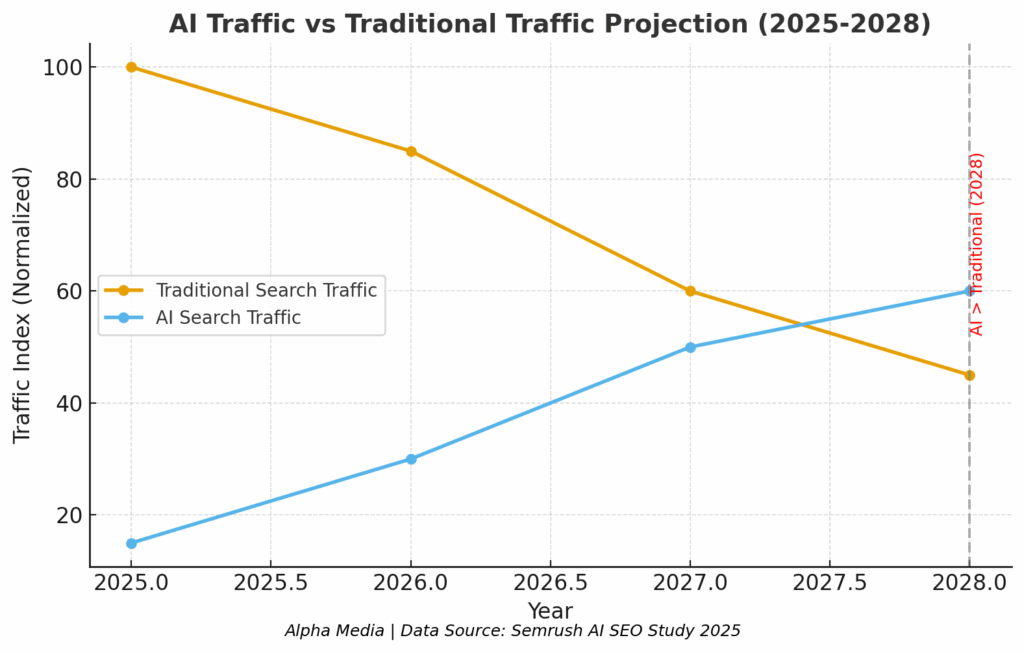
Chart me aap clearly dekh sakte ho:
- 2028: AI traffic overtakes traditional search.
- 2025: Traditional search abhi bhi dominant hai.
- 2026–27: AI search ka growth curve exponential hai.
Key Takeaway :
“Abhi se apna content AI-friendly banaiye, citations build kijiye, aur ensure kijiye ki aap AI search me visible ho — warna 2028 tak aapke competitors aapko completely overshadow kar denge.”
Final Thought: Are You Playing Offense or Defense in AI SEO?
AI search isn’t coming—it’s already here. Brands that adapt will own visibility. Those that ignore it? They’ll fade out.
But what do you think?
- Is AI search the death of traditional SEO?
- Will big brands dominate while smaller businesses get pushed out?
- Are we writing for people anymore—or just training machines?
💬 Share your thoughts, argue your stance, and let’s start a real conversation below.
Your Turn: Do you agree with these 6 tactics—or do you think AI SEO is just hype? Please comment Below.
Your Growth, Our Mission.
Founded with a vision to empower businesses in the digital age, Alpha Media is a full-service digital marketing agency committed to delivering measurable growth through innovative strategies. We specialize in Local SEO, Google Ads, Meta Ads, Website Design, and Online Branding tailored for B2B service providers, manufacturers, and local businesses.
🌐 About Alpha Media
Alpha Media is a results-driven digital marketing agency based in Delhi, India, led by visionary founder Anshul Sethi. With a passion for innovation and a mission to transform businesses through performance marketing, we have delivered over 800+ successful projects across 20+ countries, making us one of the fastest-growing agencies in the industry.
🚀 Our Mission
To empower businesses with powerful digital solutions that drive measurable results, build trust, and create lasting brand value.
💡 What We Do
At Alpha Media, we specialize in:
Search Engine Optimization (SEO) – Boost your Google rankings with location-wise SEO strategies tailored for local, national, and global markets.
Google Ads (PPC) – ROI-focused ad campaigns designed to drive high-intent leads.
Meta Ads (Facebook & Instagram) – Creative, conversion-optimized social campaigns.
Website Design & Development – Mobile-responsive, SEO-ready websites with smart UI/UX.
Lead Generation Funnels – Automated systems to capture, nurture, and convert leads.
Press Releases & Awards Marketing – Position your business as a market leader.
WhatsApp Automation – Personalized automation for fast and effective client interaction.
🌍 Why Choose Us?
✔ Experienced Team: 90+ digital experts, designers, strategists, and developers.
✔ Trusted by Global Brands: Clients from India, UAE, USA, Canada, and Europe.
✔ Certified by Google, Bing & Meta: We follow ethical and effective practices.
✔ Transparent Reporting: Weekly performance updates and growth tracking.
✔ End-to-End Marketing: Everything from web design to leads under one roof.
🎯 Leadership You Can Trust
Anshul Sethi, Founder & Director of Alpha Media, is a digital strategist with years of experience in performance marketing. His leadership has shaped Alpha Media into a powerhouse of innovation, creativity, and conversion. Under his guidance, the agency handles 2% of India’s digital ad spend across multiple niches.
📞 Let’s Grow Together!
Whether you are a startup or an established business, Alpha Media has the strategy, tools, and team to scale your success.
📧 Email: info@alphamedia.in
📍 Visit us at: www.alphamedia.in